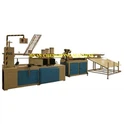
Hey there! As a supplier of Spiral Paper Core Winders, I often get asked about the electrostatic resistance of the paper cores produced by our machines. So, I thought I'd take a moment to break it down for you.
First off, let's talk about what electrostatic resistance is. In simple terms, it's the ability of a material to resist the build - up and flow of static electricity. Static electricity can be a real pain in a lot of industries. It can attract dust and debris, cause problems in electronic equipment, and even lead to sparks that might be a fire hazard in some environments.
Now, when it comes to paper cores made by our Spiral Paper Core Winders, their electrostatic resistance depends on a few factors.
1. The Type of Paper Used
The base material, which is paper, plays a huge role. Different types of paper have different levels of conductivity. For instance, papers with high moisture content tend to have better electrostatic dissipation properties. That's because water can act as a conductor to help move the static charges away. On the other hand, very dry papers are more likely to build up static electricity.
When we manufacture paper cores, we work with a variety of papers. Some are specifically treated to enhance their electrostatic resistance. These treated papers have additives that help in dissipating the static charge. For example, anti - static agents can be added during the paper - making process. These agents work by either making the surface of the paper more conductive or by reducing the friction that causes static charges to build up in the first place.
2. The Manufacturing Process
Our Spiral Paper Core Winders use a unique process that can also influence the electrostatic resistance of the final product. During the winding process, the pressure applied to the layers of paper can affect how the charges are distributed. If the layers are wound too tightly, it might create more friction, which in turn can lead to more static build - up.
We've fine - tuned our machines to ensure that the winding process is optimized for electrostatic resistance. The speed at which the paper is wound also matters. A slower winding speed can sometimes reduce the amount of static generated, as there's less friction between the moving parts and the paper.


3. Surface Finish
The surface finish of the paper core can have a significant impact on its electrostatic resistance. A smooth surface is generally better at preventing static build - up compared to a rough one. That's because rough surfaces can create more points of contact and friction, which can generate static charges.
Our Spiral Paper Core Winders can produce paper cores with a variety of surface finishes. We can apply coatings to the paper cores to make their surfaces smoother. These coatings not only improve the electrostatic resistance but also enhance the overall durability of the paper core.
Why Electrostatic Resistance Matters
In many industries, the electrostatic resistance of paper cores is crucial. For example, in the electronics industry, where even a small static discharge can damage sensitive components, paper cores with high electrostatic resistance are a must. They can be used to package and transport electronic parts safely, without the risk of static - induced damage.
In the food and beverage industry, paper cores are used for packaging. Static electricity can attract dust and other contaminants, which is a big no - no when it comes to food safety. So, having paper cores with good electrostatic resistance helps in maintaining a clean and hygienic packaging environment.
Our Product Range and Their Electrostatic Resistance
We offer a wide range of paper cores made by our Spiral Paper Core Winders, each with different levels of electrostatic resistance to suit various applications.
If you're in the market for general - purpose paper cores, our standard models have a decent level of electrostatic resistance. They're suitable for applications where the risk of static - related problems is relatively low.
For industries with more stringent requirements, like the electronics and pharmaceutical sectors, we have specialized paper cores. These are made from high - quality, treated papers and are manufactured using processes that are optimized for maximum electrostatic resistance.
We also have a selection of Paper Tube Winding Machines that can be customized to produce paper cores with specific electrostatic properties. Whether you need a high - volume production of low - static paper cores or a small batch of highly specialized ones, our machines can be adjusted to meet your needs.
Comparing with Other Machines
There are other types of paper core - making machines out there, like Toilet Paper Core Machine and Parallel Paper Core Making Machine. While these machines have their own advantages, our Spiral Paper Core Winders have some unique features when it comes to electrostatic resistance.
Our machines are designed to have better control over the winding process, which directly impacts the electrostatic properties of the paper cores. The spiral winding method allows for a more even distribution of the paper layers, reducing the chances of static build - up due to uneven pressure or friction.
How to Test the Electrostatic Resistance
If you're interested in knowing the exact electrostatic resistance of the paper cores we produce, there are several testing methods available. One common method is the surface resistance test. This test measures how easily an electric charge can flow across the surface of the paper core.
Another method is the static decay test. In this test, a static charge is applied to the paper core, and then the time it takes for the charge to decay is measured. A shorter decay time indicates better electrostatic resistance.
We can provide test reports for our paper cores to give you a clear idea of their electrostatic properties. And if you have specific testing requirements, we can work with you to conduct customized tests.
Conclusion
In conclusion, the electrostatic resistance of the paper cores produced by our Spiral Paper Core Winders is influenced by multiple factors, including the type of paper, the manufacturing process, and the surface finish. We've put a lot of effort into optimizing these factors to ensure that our paper cores meet the diverse needs of different industries.
If you're looking for high - quality paper cores with excellent electrostatic resistance, we're here to help. Whether you're in the electronics, food, or any other industry, we can provide you with the right solution. Don't hesitate to reach out to us to discuss your requirements and start a procurement conversation. We're eager to work with you and provide you with the best paper core products for your business.
References
- "Handbook of Static Electricity" by Arthur D. Moore
- "Paper and Paperboard: Materials and Processing" by James C. Roberts